


Introducing the Verafy Fact-Checker for Chrome
Every checkable claim on a page, highlighted and checked against independent sources
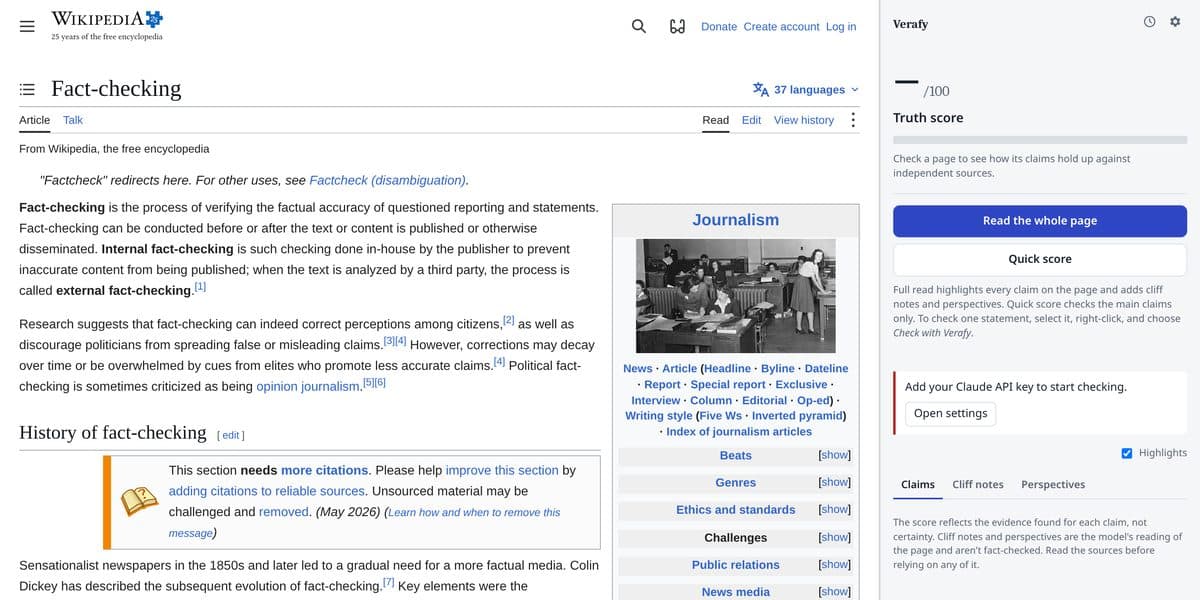
Most of what we read online is a mix of facts, opinions, and claims that sound like facts. The Verafy Fact-Checker is a Chrome extension that pulls those apart. Open it on any page and it finds the checkable claims, highlights them in place, and checks the most important ones against independent sources.
It's the third Verafy product, next to the Swarm Explorer and the Bias Detector. The Swarm Explorer checks one question across many models. The Bias Detector checks the models themselves. The Fact-Checker checks the page in front of you.
What it does
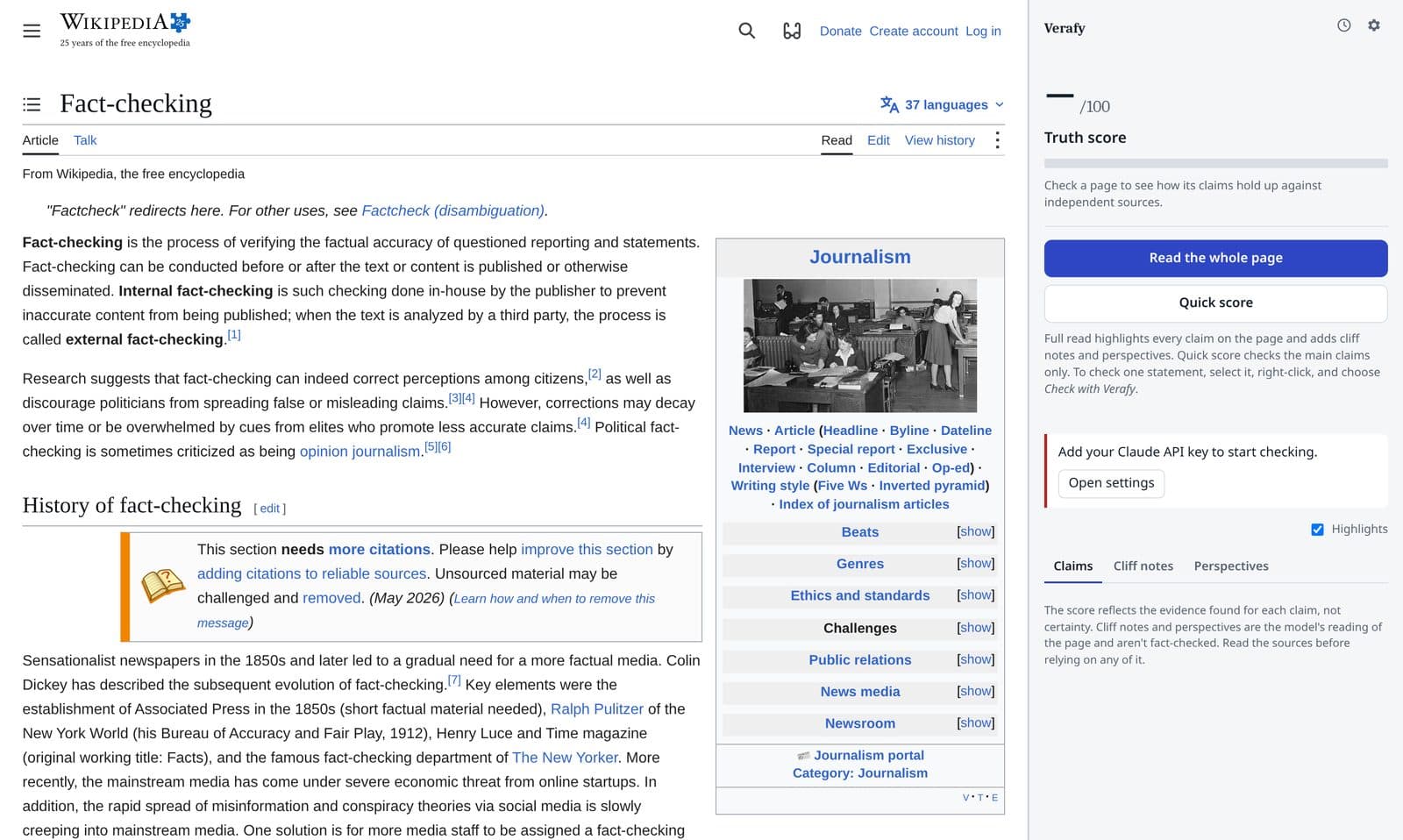
The extension lives in Chrome's side panel and has three modes:
- Read the whole page. It maps the page into sections, finds up to 40 checkable claims, and highlights each one. The most central claims are checked right away, and the highlights change color as verdicts come in: green for supported, amber for contested, red for refuted.
- Quick score. It checks only the page's main claims and gives a truth score out of 100, with no highlights.
- One statement. Select any text, right-click, and choose Check with Verafy.
A full read also adds two tabs. Cliff notes gives the gist of the page and a summary of each section, marked as fact or opinion. Perspectives shows whose view the page represents and whose is missing. Both are labeled as the model's reading of the page. They never affect the score.
How a verdict is made
The model doesn't get to pick the verdict. For each claim:
- Argue. The model searches the web, with the page's own site blocked so it can't cite itself, and writes arguments for and against the claim. Each argument has to quote a search result.
- Filter. Any argument whose source wasn't actually returned by the search is dropped. No evidence, no argument.
- Solve. The model marks which arguments attack which. A small, fixed solver (grounded semantics) decides which arguments survive.
- Score. Supported counts as 1, contested as 0.5, and refuted as 0, weighted by how central the claim is to the page. Claims that can't be verified are left out, and the panel says how many.
That design comes straight out of the Swarm Explorer work: don't trust one model's say-so, and keep the reasoning on the record.
Your history stays in your browser
Every ruling is saved locally as it's made. Come back to a page and the last ruling, highlights included, is restored without any new calls. The History view lists past rulings, and nothing in it leaves the browser.
Where it stands
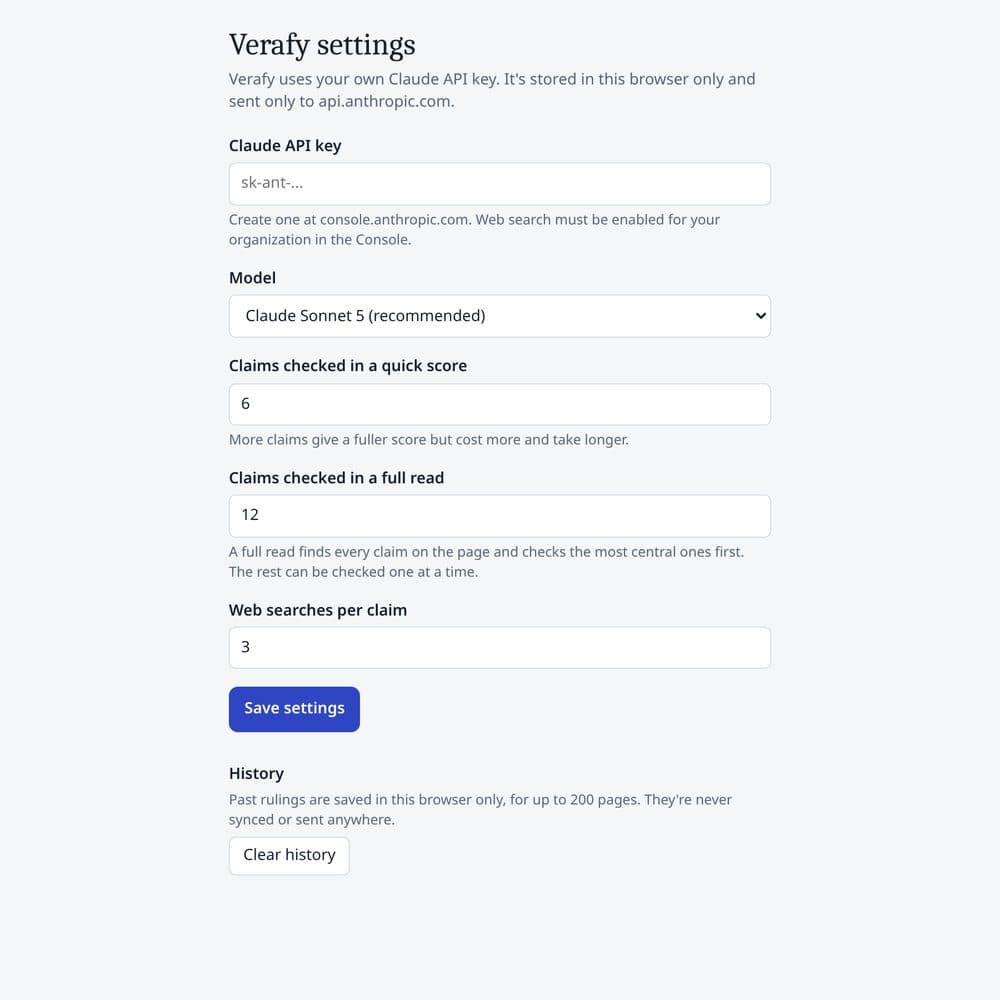
The Fact-Checker isn't in the Chrome Web Store yet. Today it runs on your own Claude API key, which is stored in the browser and sent only to Anthropic. That works for testing, but it isn't how a public release should work, so we're rebuilding it to run through the Verafy backend and to use a panel of models from different companies instead of one. That's the same jury idea behind the Bias Detector.
If you want to try it now, the source is on GitHub at Verafyai/verafy-factcheck-extension. Load the release folder as an unpacked extension in chrome://extensions with Developer mode on, open Settings, and add your key.
We'll post here when the store version is ready.