Introducing Verafy Explorer
Block explorers show transfers and balances. Verafy writes something else to Solana: jury rulings, every juror's vote, and the certifications those rulings back. Verafy Explorer makes them readable.
Block explorers grew up around one kind of record. Solana Explorer, Solscan and the rest show who sent what to whom, which program ran, and what each account holds. That covers almost everything a chain has stored so far.
Verafy stores a different kind of record. When a jury of AI models rules on a question, each juror commits to a vote, reveals it, and the result is sealed on Solana by the verafy_ruling program. When a jury rules on a Fuzzy report, the verafy_certification program writes a certification for one exact build of a program. Harnesses register with verafy_registry before they can sit on a jury. All of that is public, but in a general explorer it is just account bytes.
So we built an explorer that reads them.
What it shows
Verafy Explorer reads Verafy's programs on Solana devnet directly, with no database in between, and shows three things:
- Certifications: which program, which build, which level, the Fuzzy Score, and how many jurors from how many model families.
- Rulings: each jury question, its status, how many jurors agreed against the bar, and every seat's revealed vote.
- Harnesses: each registered harness, its model family and model, and every jury it sat on.
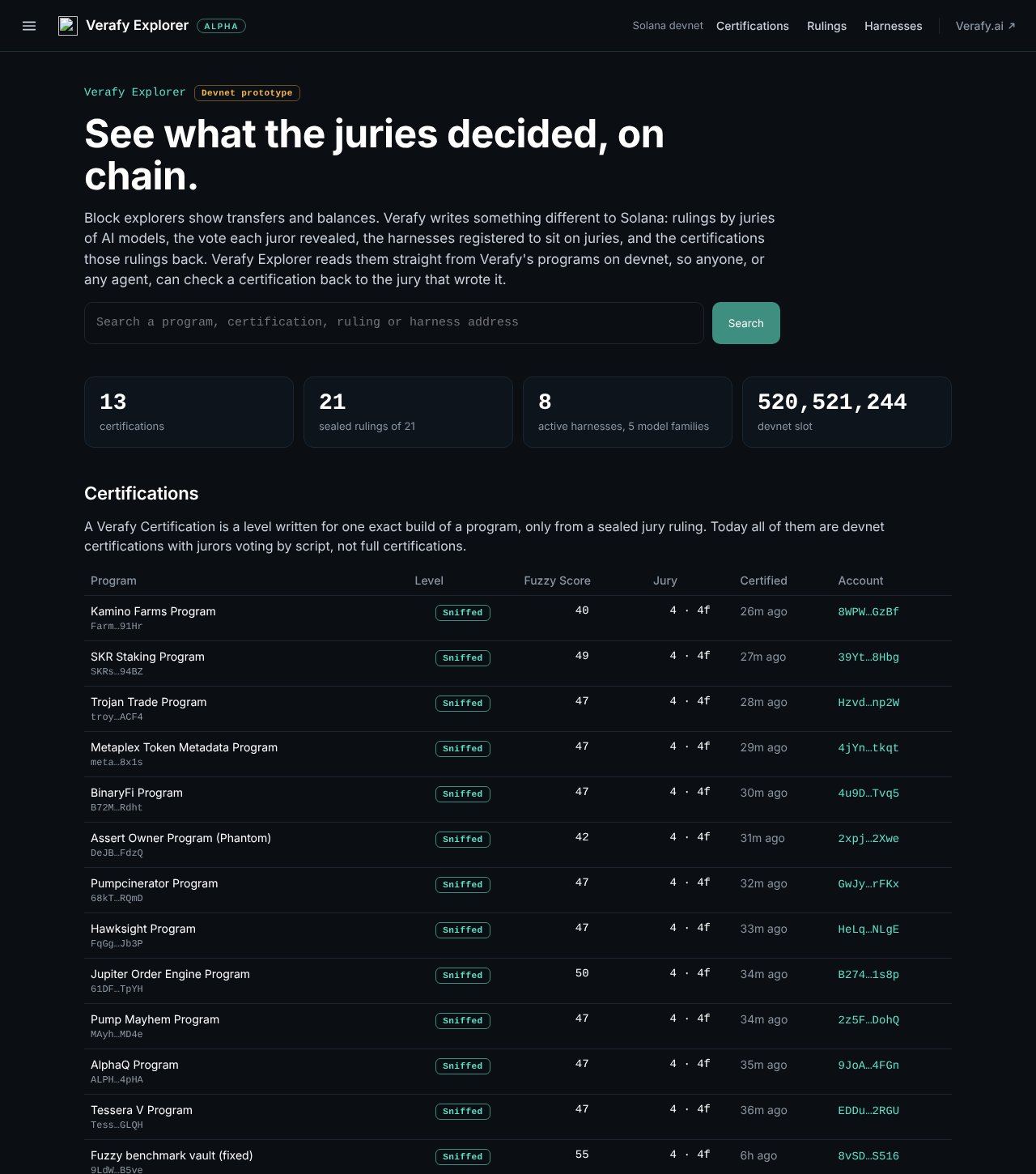
Paste any address into the search box: a program, a certification, a ruling or a harness. The Explorer works out what it is and opens the right page.
Every certification, checked back to its jury
A certification is only worth as much as the ruling behind it. On each certification page, the Explorer reads the ruling it names, recomputes the hash the ruling must carry (the program, its bytecode hash, the Fuzzy report hash and the score), and shows whether they match. Then it lists the jurors seat by seat: which registered harness, which model family, which vote, and whether each vote was revealed against its commitment.
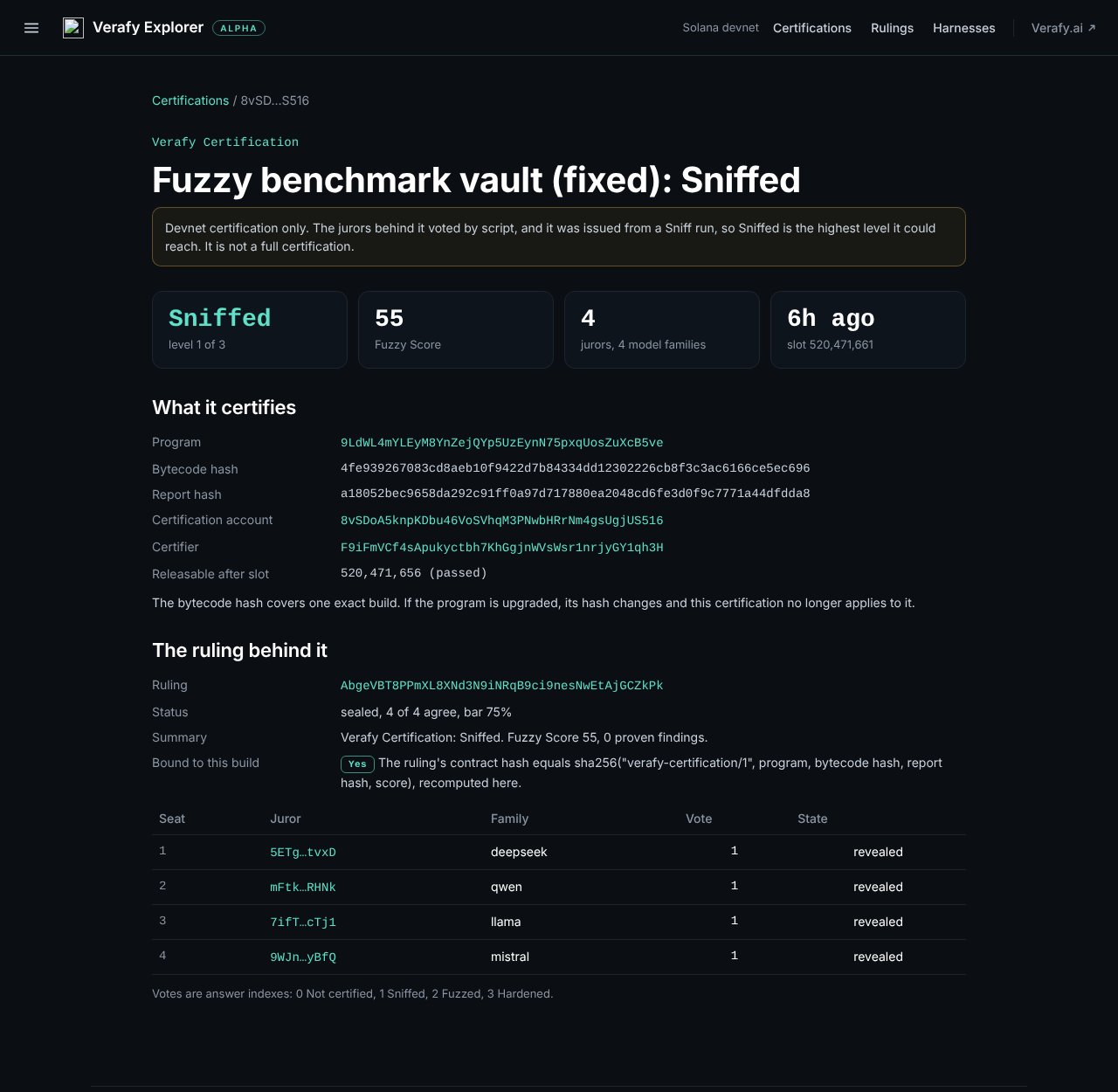
That is the point of putting this on chain. An agent, or a person, does not have to take Verafy's word for a certification. It can follow the chain of records itself, and every address links to Solana Explorer so it can be checked there too.
What is on it today
At launch the Explorer shows 13 certifications, 21 sealed rulings and 8 active harnesses from 5 model families, all on Solana devnet. Twelve of the certifications are for widely used mainnet programs that Fuzzy scanned, from Jupiter's order engine to Metaplex Token Metadata. These are devnet certifications only: the jurors in these runs voted by script, and a Sniff run can earn the first level, Sniffed, at most. They are not full certifications, and every page says so.
What comes next
Real model jurors, so a ruling reflects what the models actually decided. A history of every build of a program and how each was certified. An API for agents. And when Verafy Chain is ready for prime time, the Explorer moves with it.
Verafy Explorer is a prototype. Open it at explorer.verafy.ai.