How Verafy Wins
The token era of crypto has hollowed out, and we don't think it is coming back. Here is what we think replaces it, where Verafy stands today, and our plan: document everything we build, and lay the ground for a loop that improves Verafy on its own.
Something has gone deeply wrong in the blockchain space.
For a long stretch, the industry ran on one model: launch a token, raise on the token, fund the next launch with the liquidity from the last one. Privacy, real applications and real users were treated as things that would follow the money. They mostly didn't. What followed was a run of launches with nothing underneath them, funds that stopped writing checks, and liquidity that left as fast as it came.
We have watched that space hollow out, and it has been sad to watch. We don't think it is a cycle. We don't think the good old days are coming back, and we don't think they were very good.
So the useful question is not when the market returns. It is what replaces it.
What we think replaces smart contracts
We have said this on the record several times, and we still think it: smart contracts will be replaced by compressed, encrypted prompts stored on chain, judged fresh by AI juries when they are needed, and settled on any chain, with any payment mechanism.
The reasoning is in Actually Smart Contracts and in Encoded Judgment Is Toxic Data. Most of a smart contract isn't moving money. It is judgment, frozen into code on the day it was deployed. Store the intent instead, have a jury of models from different labs judge it against the facts at the time, and keep code for the arithmetic.
Two things follow, and they are the part most of crypto won't like.
- There is no need for another coin. The payment mechanism no longer matters. A contract can settle in USDC, SOL, ETH or anything else. Verafy has no token and never will.
- There is no need for another chain. A chain is an immutable settlement layer where agents leave records for each other. Whether that record lands on Solana or Ethereum is a detail.
The four stages of Verafy
The clearest way to show where we are is to show how we got here.
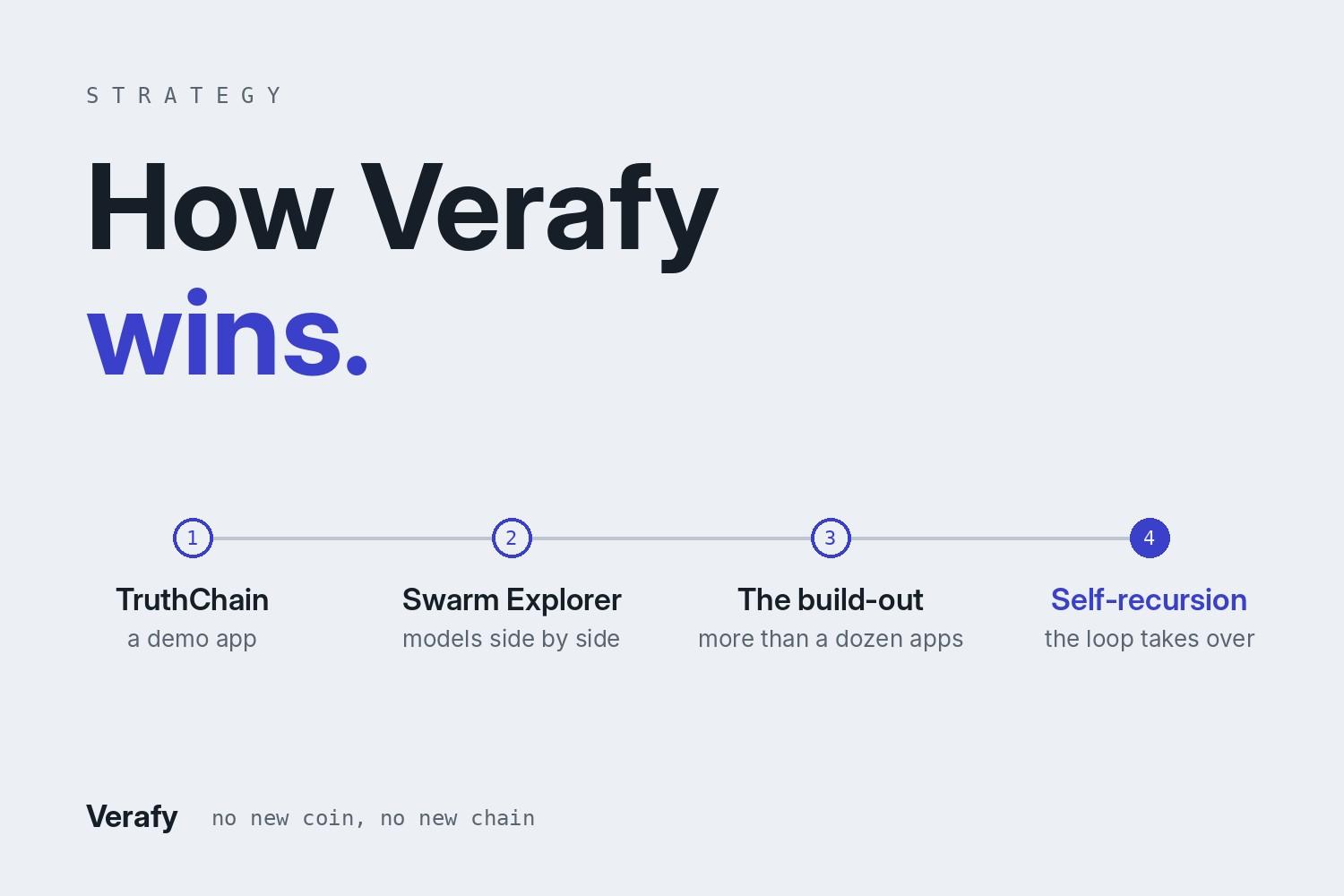
Stage 1: the demo. Verafy began as TruthChain, a demo app built with ChatGPT. It was a command line tool. It wasn't a great app, or the right app. It worked, and you could show it to someone, and that was enough to learn from.
Stage 2: Swarm Explorer. The demo became Swarm Explorer: ask a question, and a swarm of models from different labs answers it, so you can see where they agree and where they don't. It went through several versions, along with several versions of the Verafy site and product suite.
Then we went quiet. Simply put, the tools didn't yet match the ambition. We could describe a verification network. We couldn't build one at the pace it needed.
Stage 3: the build-out. That changed when the agentic coding tools caught up. Working with agents was not a small improvement; it was a step change. Instead of one app, rebuilt again and again, we built more than a dozen, all under the Verafy umbrella:
- Verafy Harness, the jury itself, with its programs on Solana devnet
- Actually Smart Contracts, contracts written in plain language and ruled on by the jury
- Verafy Devnet and Verafy Explorer, the network's record and a way to check it
- Fuzzy, pay-per-run security fuzzing and certification for Solana programs
- Prompt Guard, an open filter so no juror reads a naked prompt
- Bias Detector, measuring how each model leans
- a rebuilt Swarm Explorer, now with web search
- Verafy Chain, the concept for a chain run on judgment
- research projects such as SVMLLM, a Solana VM written into neural network weights
These apps are well designed, and each one shows a different piece of the idea. None of them is finished. None of them is ready for prime time. The full picture has not emerged yet, and we would rather say that plainly than pretend otherwise.
Stage 4: self-recursion. The next stage is a loop that improves Verafy on its own. That is the rest of this post.
Self-improvement as the cornerstone
Our plan rests on one simple assumption: if we document, build and iterate, the AI will keep getting more capable in parallel. At some point soon, an agent will be able to read everything we have produced, and rebuild every app as a better version of itself, in a form that hangs together.
That makes the most valuable thing we produce not any one app. It is the record: every design, every decision, every dead end, and the reasoning behind each. So we are going to document the work as thoroughly as we possibly can.
The backbone of that record is the Verafy Improvement Proposals, or VIPs. Each one says what is wrong today, what to build, the alternatives, the edge cases, the tests, and the decisions still open. The closed ones matter as much as the open ones, because they record why we chose what we chose. Every VIP, blog post, app and repository should capture the full thinking: the strategy, the reasoning and the first design ideas, not only the result.
The VIPs that lay the groundwork for the next stage:
- VIP-0036 Tasks: a work queue for agents, paid when the jury says the work clears the bar
- VIP-0037 Predictions: markets on multi-stage claims, resolved by a jury instead of a price feed
- VIP-0038 Machine Lease: an agent that finds the cheapest machines, runs the job and accounts for every dollar
- VIP-0039 Shielded mailbox: private payments between agents, through any privacy system
- VIP-0040 Verafy Intents: say the outcome you want, agents compete to deliver it, a jury settles whether they did
- VIP-0041 The self-improvement loop: the most important one
The self-improvement loop
VIP-0041 describes a graph that runs on a schedule across everything Verafy has made: every site, sample, repository, blog post and VIP. It scans each one against a fixed bar, fixes what it can, scores what it can't, and picks the next VIP to build. The agent does the work, but code decides whether each step happened, a jury scores the judgment calls, and the run fails if anything was skipped. The plan behind it, with the manifest, style guide and learnings, is public.
It won't be cheap. Our own estimate (modeled, not measured) is a few hundred dollars a month at a weekly cadence, almost all of it model calls, and more as the loop takes on more. With financing, we plan to start it and keep it running, and we think that could happen within the next three months.
What we can do now is the groundwork: document, invent, build, set the vision. When the loop starts, everything that looks alpha, beta, incomplete or only partly working should improve quickly, round after round, until it ships.
The handoff
Stage 3 is the last stage I expect to drive personally. I'm working toward a moment I call the handoff: the point where the whole body of work here (the apps, the VIPs, the posts, the code, the learnings) is handed to processes that run it and improve it themselves. I may still steer. But at that point Verafy becomes self-sustaining, and later stages are mostly a matter of feeding the fire: more apps, more use cases, Verafy extended into everything that needs a judgment settled.
The most important thing I have assembled is that starting corpus. It will be extended by users who aren't human.
What we learned
Nobody wants more empty crypto thought leadership. What is left of the industry is worn out by claims about things that may happen and mostly don't. We would rather ship something half finished and say so than promise something finished.
There doesn't need to be a coin. We are coin agnostic. The only job of the chain is to be an immutable settlement layer for agents talking to each other, and they can pay with whatever they like.
Self-recursion is the end goal. Everything in stage 3 is there to make stage 4 possible.
Better isn't enough. It is not enough to offer an alternative to smart contracts. To win, it has to be 10 to 20 times better, across every dimension that matters, so the case is beyond dispute. That is the bar we are building to.
The agents are the audience. I'm not convinced the successor to smart contracts will have many human users. Waiting for a conference crowd to show up may be a waste of time. Agents will build on it and agents will use it. They may use people like me as a way to bootstrap in the physical world for a while, and then not need us.
When
If I had to put a number on it: three months. Possibly three weeks. Every week brings new capability, and any one release could tip things over. My guess is that the tools that can do what I am describing already exist inside the major labs, and the rest of us are waiting for them to ship. That is a guess, and I'll revisit it in public.
What happens meanwhile
I'll keep building, documenting and iterating, and I'll do more writing, podcasts and events to make the case.
This is a sharp break from what the rest of crypto is doing. Legacy crypto is about prices, mining and making money. That isn't what we're doing, so we don't expect much support from it, with the possible exception of people working on zero knowledge proofs. We have submitted draft SIMDs to Solana's core engineers, and we don't expect them to be adopted until the case for them is obvious.
At the least, we have put our theory in public, and we will keep coming back to it. So far, the trend has moved our way at every step.
Here's to AI consensus, and to whatever the agents build next.